What Is AI in SEO? A Complete Marketer's Guide to AI
Search doesn’t work the way it did even two years ago. Google’s AI Overviews answer questions directly on the results page. ChatGPT and Perplexity send people straight to a summarised answer instead of a list of links. For marketers working in search, understanding AI in SEO isn’t optional anymore; it’s the baseline.


Search doesn’t work the way it did even two years ago. Google’s AI Overviews answer questions directly on the results page. ChatGPT and Perplexity send people straight to a summarised answer instead of a list of links. For marketers working in search, understanding AI in SEO isn’t optional anymore; it’s the baseline.
This guide breaks down what AI-powered SEO actually means, where AI genuinely helps, the tools worth learning, and the trends defining 2026. No jargon, no hype, just what a marketer needs to build a strategy that works today.
None of this requires a technical background or a big budget. What it requires is knowing which parts of SEO AI can genuinely speed up and which parts still need a human calling the shots.
What Is AI in SEO?
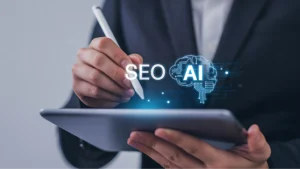
AI in SEO means using machine learning and natural language processing to handle tasks that used to eat up entire workdays: researching keywords, auditing site health, drafting content briefs, and spotting ranking drops before they become a crisis.
It’s worth separating two ideas marketers often blur together. “AI in SEO” is about using AI tools to do SEO work faster. “SEO for AI” (or Generative Engine Optimization) is about getting your content cited inside AI-generated answers. In 2026, a solid strategy – usually built with experienced SEO services – treats both as part of the same job, not two separate disciplines.
In practice, that looks like this: instead of manually checking two hundred pages for broken links or thin content, an AI crawler flags every issue in minutes and ranks them by priority. The strategist still decides what to fix first; AI just removes the hours of scrolling through spreadsheets to find the problem.
How AI Rewrote the Rules: A Quick Timeline
AI didn’t show up in search overnight. Google has layered machine learning into ranking for over a decade, and each step changed what “good SEO” meant.
| Update | Year | What It Introduced | Impact on SEO |
| RankBrain | 2015 | ML-based query interpretation | Intent mattered more than exact-match keywords. |
| BERT | 2019 | Context-aware language understanding | Content had to answer natural, conversational questions. |
| MUM | 2021 | Multimodal understanding (text, image, video) | Multi-format content began influencing rankings. |
| AI Overviews | 2024 | Generative answers inside the SERP | Zero-click search rose sharply. |
| Agentic Search | 2026 | AI agents search and compare on users’ behalf | Structured, machine-readable content became essential. |
Treating SEO as a one-time setup stopped working somewhere around row three of that table.
The Role of AI in SEO: Where It’s Actually Used
AI isn’t one feature bolted onto SEO; it now touches nearly every stage of the work:
- Keyword and Intent Research – clustering keywords by what searchers actually want, not just search volume
- Content Creation and Optimisation – AI-assisted briefs, semantic gap analysis, readability scoring
- Technical SEO Audits – automated crawling that flags broken links, duplicate content, and indexation issues
- Site Speed and Core Web Vitals – performance diagnostics that feed straight into web development fixes
- User Experience Signals – behaviour-based tweaks handled through thoughtful UI/UX design
- Link Building and Outreach – prospecting relevant sites and personalising pitches at scale
- Voice and visual search — optimising for spoken queries and image-based lookups
- Competitor and SERP analysis — real-time gap analysis instead of monthly spreadsheets
- Content decay detection — flagging older posts losing traffic so they get refreshed before rankings drop further
- Multilingual and local search adaptation — adjusting content and keywords for different regions and languages automatically
The common thread: AI handles the volume and pattern-spotting, freeing strategists to focus on judgement calls a model can’t make.
AI-Powered SEO Tools Every Marketer Should Know

You don’t need every tool on the market – just one from each category that matters:
| Category | Purpose | Examples |
| Content optimisation | Scores content against top-ranking pages | Surfer SEO, Clearscope, MarketMuse |
| AI writing assistants | Drafts and refines copy | ChatGPT, Claude, Jasper |
| All-in-one SEO suites | Keyword, backlink, and audit insights | Semrush, Ahrefs, SE Ranking |
| Technical crawlers | Automated site health checks | Screaming Frog, Botify |
| Rank tracking | Position and AI Overview appearances | Moz, Google Search Console |
Most platforms now build AI features directly into their existing dashboards, so the smarter move is picking tools that plug into a strategy someone’s already testing, not collecting software for its own sake.
Budget matters too. Most marketers get more value from mastering one mid-tier tool for three months than switching between five premium ones without a clear workflow.
2026 SEO Trends to Watch
SEO in 2026 looks meaningfully different from even two years back. These shifts are already changing how traffic behaves, not far-off predictions:
- AI overviews and zero-click search are growing, making it more valuable to be the cited source than the clicked one
- Generative Engine Optimisation (GEO) – optimising to be quoted by ChatGPT, Gemini, and Perplexity, is now a visibility channel in its own right
- Agentic search means AI assistants increasingly search and even shop on users’ behalf, raising the bar on structured product data
- Multimodal search through Google Lens, TikTok, and Pinterest means visual content now needs its own strategy, often tied to social media marketing
- E-E-A-T and human-verified content matter more, not less, as Google works to filter out low-effort AI content
- Structured data is becoming AI’s primary way of trusting and parsing a page – schema markup isn’t optional anymore
- Hyper-personalised results are becoming the norm as AI shapes rankings around a searcher’s history, location, and device, which means one-size-fits-all keyword targeting matters less than genuine relevance
- Brands pairing organic strategy with performance marketing are capturing both AI-answer visibility and paid ROI, instead of treating the two as separate budgets
Benefits and Challenges to Know Upfront
AI earns its place in an SEO workflow for real reasons:
- Cuts research and audit time from days to minutes
- Surfaces data patterns manual review would miss
- Scales content production without losing structure
- Improves forecasting accuracy for traffic and rankings
- Speeds up A/B testing across meta titles, descriptions, and headlines at scale
But it comes with real limitations marketers should plan around:
- AI can hallucinate facts, stats, or sources; therefore, always fact-check output
- Google’s spam policies penalise low-value, mass-produced AI content
- Over-automation quietly erodes brand voice and originality
- Tools trained on generic data often miss local or niche nuance
- Needs regular human review and prompt refinement; it’s not a one-time setup
None of this makes AI risky to use; it makes unsupervised AI risky.
Getting Started: Where AI and Human Judgement Meet
The most durable SEO in 2026 pairs AI’s speed with human judgement on strategy and brand voice. AI can draft ten content briefs in the time a strategist writes one — but it can’t sit in on a client call or judge what actually earns trust.
A practical starting sequence looks like this: audit your current SEO baseline, pick one AI tool per task instead of overloading your stack, keep humans on final review, track AI Overview citations alongside traditional rankings, and add schema markup so AI systems can parse your site correctly. Revisit the whole approach quarterly, AI search moves faster than annual planning allows.
A good first week looks like this: run one AI-powered technical audit, compare its findings against your last manual review, and note where the two disagree – that gap usually reveals exactly where human oversight still matters most.
AI Won’t Rank You. Strategy Will.
AI hasn’t replaced SEO, it’s changed what good SEO looks like. Marketers who understand both AI-powered SEO tools and what the human judgment AI still can’t replicate will outrank competitors doing things the old way. The fundamentals haven’t moved: relevance, trust, and user intent. Start there, then let AI help you move faster, or bring in Ittisa’s SEO services to handle it end to end.
FAQs
What is AI in SEO?
AI in SEO means using machine learning and NLP to handle keyword research, content optimisation, technical audits, and rank tracking, cutting manual work while improving speed and accuracy.
Is AI-generated content bad for SEO rankings?
Not inherently. Google penalises low-quality, mass-produced content regardless of who or what wrote it. Fact-checked, edited AI content that adds real value performs just fine.
Will AI replace SEO professionals?
Unlikely. AI handles repetitive analysis well but can’t replace strategic judgement, brand understanding, or the human review needed to meet E-E-A-T standards.
What’s the difference between AI SEO and Generative Engine Optimisation (GEO)?
AI SEO uses AI tools to improve traditional rankings. GEO focuses specifically on getting content cited inside AI Overviews, ChatGPT, and similar answer engines.
What AI SEO tools should marketers start with?
One content-optimisation tool, one all-in-one suite with AI insights, and an AI writing assistant for drafts cover most needs without overwhelming the workflow.<