Generative Engine Optimization For D2C Brands - 2026

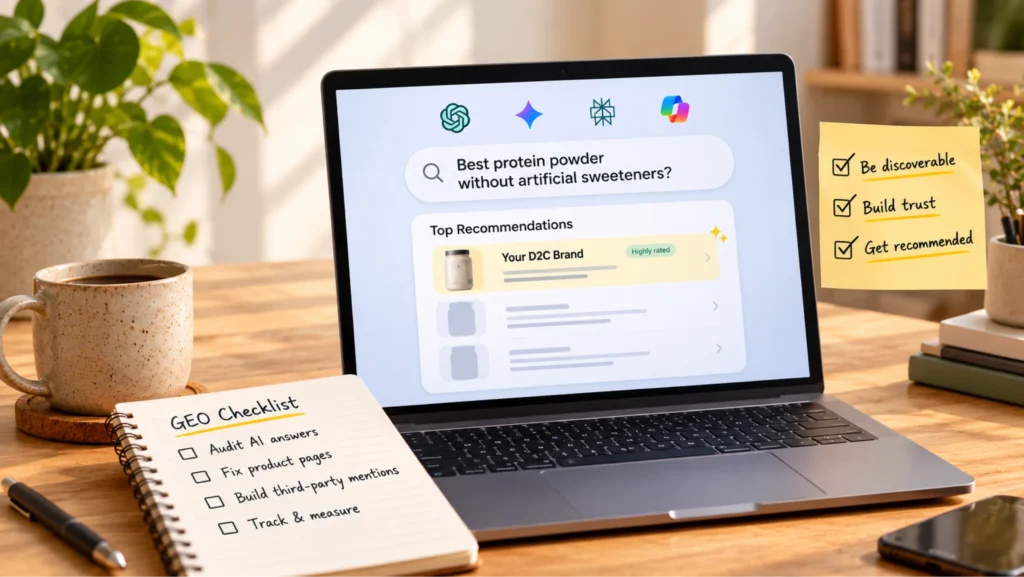
Try something tonight. Open ChatGPT, Gemini, or Perplexity and ask the question your best customer would ask before buying from you. Something like “best protein powder without artificial sweeteners” or “running shoes for flat feet.” Type it the way a real person would, typos and all.
Now read the answer. Is your brand in it? If yes, is what it says about you true? If not, who got your spot?
That little experiment is why everyone suddenly talks about generative engine optimization, or GEO. People still use Google, but more of them now ask an AI to do the comparing, and it hands back a short list instead of ten blue links. Miss the list, and you’re not in the race. Here’s how we at Ittisa explain GEO for D2C brand owners in plain language, plus what we’d do first.
So what is GEO, really?
GEO is the work of making your brand easy for AI answer engines to find, understand, trust, and recommend. Think ChatGPT, Gemini, Perplexity, Copilot, and the AI summaries that now sit on top of many Google results.
SEO asks how you rank on page one. GEO asks whether your brand shows up inside the answer when someone asks an AI for advice. The two overlap a lot, and good SEO still helps. But the finish line moved. You’re no longer fighting for a click on a list. You’re trying to get named, and ideally cited, in a written response.
Here’s the bit we find comforting: most of GEO is plain good marketing done with more discipline. Clear product information, honest reviews, other people talking about you in places you don’t control. No secret trick required, just a willingness to stop skipping the boring parts.
Why D2C brands feel this first
If you sell through your own store, you’re in an awkward spot. Big retailers and marketplaces have years of pages, reviews and links behind them, so AI models have seen them everywhere. A younger D2C brand leaves a smaller footprint, which means the model knows less about you.
Meanwhile, the questions people ask AI are the ones D2C brands exist to answer. “Best moisturizer for dry skin in winter.” “A mattress for back pain that doesn’t cost a fortune.” “Is this brand legit?” Specific, comparison-heavy, slightly anxious. The AI replies with a shortlist, which plenty of shoppers trust more than a row of ads.
And it’s moving past recommendations. In 2026, assistants compare prices, summarize reviews and, in some places, even complete the purchase. Whatever they can’t read clearly, they can’t sell.
So the upside is real, and so is the risk. A small brand that explains itself clearly can sit next to the giants. A brand that’s vague, inconsistent, or barely mentioned elsewhere gets skipped. That’s why GEO for D2C brand teams deserves a spot on the roadmap now, even if AI referrals are still a modest slice of your traffic.
Start by interrogating the machines
Before you change anything, find out where you stand. It takes an afternoon, and it’s humbling.
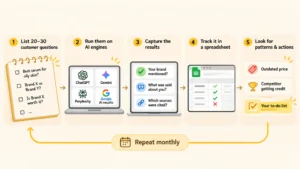
Write down 20 to 30 questions a customer might ask before buying what you sell. Include the obvious ones (“best serum for oily skin”), the comparison ones (“Brand X vs Brand Y”), and the nervous ones (“is Brand X worth it?”). Run each through ChatGPT, Gemini, Perplexity, and Google’s AI results. For every answer, note whether you were mentioned, what was said about you, and which sources got cited.
Drop it all in a spreadsheet and repeat it monthly. Answers wobble from day to day, so don’t panic over one bad result. Look for patterns. You’ll probably find something uncomfortable, like an outdated price, or a competitor getting credit for a feature you launched first. Good. That’s your to-do list.
Make your product pages say something
Our most unpopular opinion: a lot of D2C copy is too poetic. “Crafted for the modern woman who does it all.” Lovely. Also useless to a machine trying to figure out what your product is and who should buy it.
AI engines pull facts, so hand them facts in plain sentences, near the top of the page. Say what it is, who it’s for and who it isn’t for. List ingredients, materials, sizes and certifications. Add price, shipping time and return policy. Explain how it differs from the usual alternatives. That “who it isn’t for” line feels risky, but it builds trust and gives the AI a clean reason to recommend you to the right people.
Write the description the way you’d explain the product to a friend who’s about to spend their own money on it. Then add structured data (schema markup) for products, offers, reviews and your organization, and keep price and stock accurate.
If you’re on Shopify, check that key details aren’t injected late by an app or widget, since some crawlers never run that code. Also make sure your robots.txt or bot-protection settings aren’t blocking AI crawlers by accident. If a crawler can’t see it, it might as well not exist.
Get talked about on pages you don’t own
Most founders underestimate this part. AI models don’t just trust what you say about yourself. They look for agreement across the web. If five independent places call your brand the best option for sensitive skin, the model will probably repeat it. If the only place saying so is your own homepage, it may not.
So map out where your category gets discussed: review sites, “best of” roundups, YouTube comparisons, Reddit threads, niche newsletters, podcasts. Show up there honestly. Send products to reviewers who’ll tell the truth, and pitch the writers who already make lists in your space. Answer questions in communities as a person, not as a logo. And please don’t astroturf Reddit. People spot it fast.
One cheap trick that works: rewrite your post-purchase review email. Swap “How did we do?” for “Who did you buy this for, and what problem did it solve?” You’ll get reviews like “bought it for my dad’s bad knees,” which sounds a lot like how people phrase questions to AI.
Measuring something that won’t sit still
GEO measurement is messy, and anyone who says otherwise is selling a dashboard. Track how often you’re mentioned across your question list each month. Check your analytics for traffic from sources like chatgpt.com and perplexity.ai. Add “ChatGPT or another AI tool” to your “how did you hear about us?” survey. And watch branded search, since people often hear about you from an AI and then Google your name.
Plenty of AI mentions will never turn into a trackable click. That’s fine. Treat the numbers as a compass, not accounting.
Mistakes we’d skip
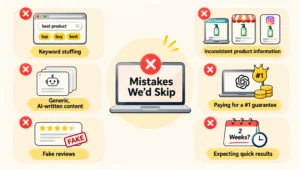
Stuffing pages with keywords for the AI. Publishing piles of generic, machine-written articles, which is just one more beige sandwich on a crowded shelf. Faking reviews. Engines and shoppers both sniff those out. Describing your product three different ways on your site, your marketplace listings, and Instagram. Paying anyone who guarantees you’ll be number one in ChatGPT, because nobody can promise that. And expecting results in two weeks. This is slow, compounding work.
One last thought
GEO for D2C brand growth isn’t a trick for gaming a chatbot. It’s the old job of being clear, honest, and worth recommending, with a new audience reading over your shoulder. Run the audit this week, fix one product page, and see what changes. You’ll learn more from that than from any article, including this one.
Want a hand? Come talk to us at Ittisa.
FAQs
What is GEO, and how is it different from SEO?
GEO is about getting your brand mentioned and cited inside AI-generated answers, while SEO is about ranking in a list of links. You still need both. They share foundations like quality content and credibility, but GEO leans harder on clear facts and on what other sites say about you.
How long does it take to see results?
Expect a few months, not a few weeks. Fixing your own pages can show up faster, but earning third-party mentions and reviews takes time. Judge progress by trends in your monthly audit.
Can I track whether ChatGPT or Gemini recommends my brand?
Partly. Manual audits, AI referral traffic in your analytics, and a “how did you hear about us?” survey give a useful picture. Paid tools exist, but AI answers vary by person and by day, so no number is exact.
Is it okay to use AI to write my GEO content?
For research and first drafts, sure. For the final version, add your own details, opinions, and real customer language. Generic content is easy to produce, which is why it rarely stands out.
Does GEO matter for a small D2C brand with a tiny budget?
It suits small brands well. Most of the work is free: better product pages, clearer answers, asking happy customers better questions. You don’t need a big team, just consistency.