Best 10 AEO Tools for B2C Companies in 2026


Picture this. A shopper types “best vitamin C serum for sensitive skin” into ChatGPT. Your product isn’t in the answer. Two competitors are, along with a Reddit thread you’ve never seen.
That’s the gap answer engine optimization (AEO) tools try to close. They show where your brand appears in AI answers, who gets recommended instead, and which sources the AI trusts. The better ones also tell you what to fix. Think of them as mystery shoppers that work around the clock.
Doing AEO for B2C brand teams isn’t the same game as the B2B version. Shoppers ask messier questions, in bigger volumes, and act on the answer fast. So this list leans toward ecommerce, retail, and local businesses. Prices change constantly, so treat the numbers below as ballpark and check each vendor’s page before you commit.
Before you buy anything

Demos always look good, so ask these first.
- Which engines does it watch? ChatGPT, Gemini, Perplexity, and Google’s AI Overviews are the bare minimum for most consumer brands.
- Can it see products, not just your brand? Shoppers rarely ask about your company. They ask for “waterproof hiking boots under $150.” Product-level tracking is rare and often hides on pricier plans.
- How many prompts do you get? Cheap plans can cap you at a few dozen, which barely covers one category. Good AEO for B2C brand work starts with prompts that sound like real shoppers, so make sure you can write your own.
One last thing. AI answers shift from run to run, so read every dashboard number as a trend, not a verdict.
The 10 tools
We’ve ordered these roughly from lightest lift to heaviest, not from best to worst. The right pick depends on your size and budget.
1. Otterly.AI
Think of Otterly as the “let’s see if this even matters” option. It reruns your prompts daily across ChatGPT, Google AI Overviews, Perplexity, and Copilot, then reports mentions, cited pages, sentiment, and competitor comparisons. Plans start around $29 a month, though that tier covers only a small prompt set. It monitors rather than fixes, so you’ll work out next steps yourself. Great for a small DTC brand that’s testing the waters. You’ll likely outgrow it once AI starts driving real revenue.
2. Peec AI
Peec keeps things deliberately simple: set up prompts, watch your visibility, act on the top citations. This Berlin-based tool also benchmarks you against named competitors, tracks sentiment, and handles multiple countries and languages well, which helps if you sell across borders. Every plan includes unlimited seats. The catch is that it measures a lot and recommends little, so pair it with someone who knows what to do with the data. Plans start around $95 a month.
3. AthenaHQ
AthenaHQ tries to be useful before you publish. Its citation engine scores how likely a page is to get cited, and a knowledge base helps you catch and correct what AI gets wrong about your brand. That second part matters for B2C, where a wrong price, opening time, or ingredient list can cost you actual customers. There’s a free tier to poke around in, but it’s a trial, not a plan, and the strongest features sit on higher plans.
4. Semrush AI Visibility Toolkit
If your team already lives in Semrush, this is the path of least resistance. One login, one invoice, no new vendor for finance to vet. It adds prompt tracking, brand performance, and competitor views on top of the keyword data you already use, for around $99 a month per domain. It’s less exciting than the specialists, and per-domain pricing adds up fast across several brands. Product-level shopping tracking sits in the enterprise tier, so smaller shops mostly get brand-level insight.
5. Ahrefs Brand Radar
Same logic as Semrush, different camp, and handy if your SEO lead already swears by Ahrefs. Brand Radar is an add-on that tracks how often your brand appears across Google’s AI Overviews and AI Mode, ChatGPT, Perplexity, Gemini, and Copilot. It also catches brand mentions around the wider web, which most pure AEO tools don’t. Budget for the add-on plus a base Ahrefs plan, and don’t expect shopping-specific features here.
6. Yext Scout
Not every B2C brand sells through a cart. If you run clinics, hotels, bank branches, or a retail chain, “near me” questions matter more than product cards. Scout is built for multi-location brands. It tracks AI and traditional search visibility from national down to hyper-local, compares each location with nearby competitors, then helps you fix listings, reviews, and local pages inside Yext.
7. Scrunch AI
Scrunch asks a different question: can AI even read your site properly? Most dashboards never check, and a store AI can’t read is a store AI can’t recommend. Its Agent Experience Platform serves AI-friendly versions of your pages to bots without changing what shoppers see, which helps catalog-heavy stores with complex specs. It also has a shopping view. Pricing starts in the low hundreds per month, and the fixes lean technical, so get a developer in the room early.
8. Goodie
Goodie leans hardest into retail. Its Agentic Commerce Suite tracks individual products across ChatGPT Shopping, Perplexity Shopping, Amazon’s Rufus, and Google’s AI Mode shopping, flags feed and schema problems, and tries to tie visibility to actual carts and revenue. That’s the question your CFO will eventually ask. SKU-level tracking sits on higher-tier plans, and there’s a learning curve if all you wanted was a simple dashboard. Ask them to demo it on your catalog, not a polished sample.
9. Profound
Profound is the heavyweight. It watches a long list of AI engines, estimates how often people ask about topics in your category (it calls this Prompt Volumes), and has a dedicated ChatGPT Shopping view. The entry plan is thin, so budget for a higher tier, and expect shopping tracking to sit at enterprise level. It’s worth it for a large brand with a team ready to act on all that insight. Less so if you’re one person with a Shopify store.
10. Evertune
Evertune is the research-grade option. Instead of sampling a handful of answers, it runs each prompt many times across major models, so you get a steadier picture than a single screenshot. Its Shopping Intelligence module, launched this year, looks at ChatGPT’s product cards and which retail partners drive AI discovery. Price is the sticking point: it’s enterprise-leaning and demo-led. For a big consumer brand that wants numbers it can defend in a boardroom, it deserves a call.
How to pick without overthinking it
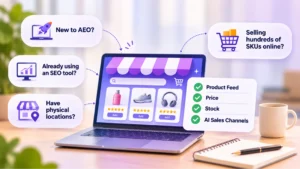
Brand new to this? Start with Otterly or Peec and find out whether AI engines mention you at all. Already paying for Semrush or Ahrefs? Try their add-ons first. Got physical locations? Look at Yext. Selling hundreds of SKUs online? Book demos with Goodie, Scrunch, and Evertune.
A cheap tracker plus one tool that helps you act is a perfectly sensible setup for AEO for B2C brand teams.
And fix the basics either way. Profound’s tracking this summer suggested that a large share of ChatGPT Shopping picks now come through connected product feeds. No dashboard will save you if your feed has missing prices or stale stock. If you’re on Shopify, check how your AI sales channels are set up first.
Where to start
Pick one tool, track a small set of real shopper questions, and treat AEO for B2C brand growth as a weekly habit rather than a one-off project. Run your first 25 prompts this week. You’ll learn more from that spreadsheet than from any demo.
Want a hand? At Ittisa, a digital marketing agency, we can help you choose a tool and build that prompt list.
FAQs
What’s the difference between AEO and GEO?
Mostly branding. Answer engine optimization (AEO) and generative engine optimization (GEO) both mean getting your brand mentioned and cited in AI-generated answers. Tools use the labels interchangeably, so don’t rule one out over the other.
Can I track this by hand instead of buying a tool?
Yes, to start. List 25 real shopper questions, run them weekly in ChatGPT, Gemini, and Perplexity, and log whether you appear and which sources get cited. Paid tools earn their keep once you need scale, history, and competitor comparisons.
How much should I budget?
Entry plans start around $29 a month, while enterprise contracts run far higher and usually mean a sales call. Check prompt limits and engine coverage before comparing prices, because a cheap plan may track ChatGPT only.
How long until I see results?
Weeks for specific product questions, longer for broad category ones, and nobody can promise dates. A tool measures progress. Your content, product data, reviews, and third-party mentions create it.
Does AEO replace SEO?
No. The two overlap, since good content and clean technical basics help both, but you measure them differently: rankings and clicks for SEO, mentions and citations for AEO. Most brands need both.