
How the D2C Industry Is Leveraging CTV as a Performance Channel to Scale Growth
If you’ve run a D2C brand for a few years, you remember when paid social felt like a cheat code. Post a few scroll-stopping videos, watch the orders come in, repeat.


If you’ve run a D2C brand for a few years, you remember when paid social felt like a cheat code. Post a few scroll-stopping videos, watch the orders come in, repeat.
Then costs crept up. Privacy changes made tracking murkier. Every competitor started chasing the same audiences in the same feeds, and a campaign that once ran itself suddenly needed constant babysitting.
So where are sharp D2C teams looking for their next stretch of growth? Increasingly, the living room. Connected TV (CTV) has moved from a brand-awareness line item to a channel performance marketers can plan and measure. Here’s why that shift is happening, and how to fold it into your D2C Performance Marketing Strategy without wasting budget.
The growth ceiling D2C brands keep hitting
Paid social and search still do the heavy lifting for most direct-to-consumer brands. Nobody’s saying otherwise. But both are crowded, and both eventually hit diminishing returns.
Once you’ve tapped your best audiences, you end up paying more to reach people who look a lot like the ones you’ve already converted. Customer acquisition costs climb. Growth flattens. The spreadsheet starts to look a little scary.
What brands need at that point is fresh reach: real people who haven’t met them yet, in a setting where they’re actually paying attention. That’s the gap CTV fills.
What actually changed about CTV
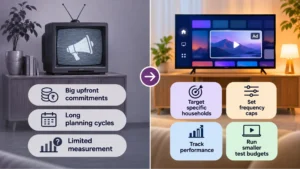
For decades, TV advertising meant big upfront commitments, long planning cycles and reports that told you very little. A small D2C brand couldn’t touch it, and a performance marketer wouldn’t have wanted to.
Streaming changed the plumbing. Ads now travel over the internet to specific households, which means they can be targeted, capped and tracked in ways linear TV never allowed. Self-serve platforms and programmatic buying made small test budgets possible. And as more big streamers added ad-supported tiers, the supply of quality inventory grew fast.
The result is a channel that behaves a lot like digital advertising, but with the big screen, the sound and the lean-back attention of old-school TV.
Why performance teams are warming up to CTV
Start with attention. A CTV ad usually plays full-screen, with sound on, and often can’t be skipped. Compare that with a thumb flicking past your video in a crowded feed. A 15- or 30-second story actually gets to land.
Then there’s targeting. You can build audiences from your own customer lists, site visitors and lookalikes, then reach them at the household level. You can also suppress existing customers, so you’re not paying to show a skincare ad to someone who already owns three bottles of your serum.
And here’s the part that gets performance teams excited: the second screen. Picture your customer halfway through a Sunday-night series, snack in one hand, phone in the other.
They’ll glance down mid-ad, search your brand name, scan a QR code or visit your site once the credits roll. Shoppable formats and household-level matching help connect that TV exposure to the eventual purchase.
There’s a halo effect too. Many brands notice that branded search, direct traffic and retargeting get stronger once CTV is running. TV warms people up, and your other channels close the sale.
How D2C brands are putting it to work
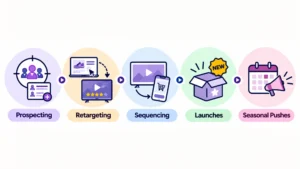
The smartest teams don’t treat CTV as a standalone bet. They give it a specific job in the funnel.
For prospecting, they upload their best customer list, build lookalike audiences and introduce the brand to households that resemble their buyers. This is where CTV earns its keep on new customer acquisition.
For retargeting, someone browses a product page and leaves. A few days later, their household sees a different message on the big screen, maybe a customer review, a founder story or a limited offer.
Sequencing is another common play. The CTV spot tells the story, and a follow-up on mobile or social delivers a tighter call to action. Each channel does what it’s best at.
Launches and seasonal pushes are a natural fit too. A new product drop or a big sale feels bigger when it shows up on the family TV.
Building CTV into your D2C Performance Marketing Strategy
A good D2C Performance Marketing Strategy doesn’t bolt CTV on and hope. It starts with a clear question: what do we want this channel to do? Win new customers, bring back window shoppers, or support a launch? Pick one job to begin with.
Next, feed it your first-party data. Your customer list and purchase history make targeting sharper and suppression smarter. The better your data, the less you pay for impressions that were never going to convert.
Then comes creative, where many D2C brands trip up. Social-first videos don’t always survive the jump to a 55-inch screen.
Show the product in the first few seconds, keep the message simple, and end with one clear call to action, like a short URL or a QR code people can scan from the sofa. Test a couple of 15-second and 30-second cuts before you commit.
Finally, give it room to breathe. Cap frequency at the household level so you’re not hitting the same family twenty times, and run the test long enough, and with enough budget, to read real signals. A tiny, two-week experiment rarely tells you much.
Measuring CTV without fooling yourself
This is where most teams get nervous, and fair enough. If you judge CTV by last-click ROAS alone, it’ll often look worse than it really is. Someone sees your ad on TV, searches your brand name an hour later and clicks a search ad. Search gets the credit. TV gets the blame.
A better approach is to measure incrementality. Run a geo holdout or matched-market test, where some regions see your CTV ads and similar regions don’t, then compare new customers and revenue.
Conversion lift studies offer another route. They answer the question that matters: would these sales have happened anyway?
Alongside that, watch the signals that move when CTV is working: new-customer CAC, branded search volume, direct traffic, blended marketing efficiency ratio and payback period. Add a “how did you hear about us?” question at checkout, with TV and streaming as options. It’s low-tech, and it’s surprisingly useful.
No single method is perfect, so pair a couple and look at the story they tell together.
Mistakes that quietly drain budgets
Most CTV disappointments trace back to a handful of avoidable errors.
- Pulling the plug after a week because last-click numbers look soft
- Running slow, brand-film-style creative with no call to action
- Skipping frequency caps and hammering the same households
- Ignoring where ads actually ran, since inventory quality varies
- Scaling spend before proving the channel is incremental
Sort these out and you’ll sidestep a lot of the “CTV didn’t work for us” stories.
Start small, measure honestly
CTV won’t replace social or search, and it doesn’t need to. What it adds is a scalable way to reach new customers on the biggest screen in the house, with results you can test.
The brands winning here treat it as one part of a full-funnel D2C Performance Marketing Strategy. They start small, test properly, and scale only what proves incremental. If you’ve been waiting for TV to feel less like guesswork, this is a good time to run your first experiment.
FAQs
What is CTV advertising, and how is it different from OTT?
CTV, or connected TV, refers to the screen itself: smart TVs, streaming sticks and game consoles that connect to the internet. OTT describes content delivered over the internet, on any device. In short, CTV advertising is the slice of OTT advertising that appears on the big screen.
Can small D2C brands afford CTV?
Yes, more easily than a few years ago. Self-serve platforms and programmatic buying remove the need for huge upfront commitments. Many brands begin with a modest slice of their prospecting budget, as long as it’s big enough to produce a readable result.
How do you measure CTV performance?
Don’t rely on last-click alone. Combine incrementality tests, such as geo holdouts, with metrics like new-customer CAC, branded search lift, direct traffic and post-purchase surveys. Together, they paint a far more honest picture.
What kind of creative works best on CTV?
Clear and simple wins. Show the product early, make the benefit obvious, and finish with one call to action, such as a QR code or short URL. Test 15-second and 30-second versions, and design for sound on and a screen viewed from across the room.
How long does it take to see results?
It varies by category and price point, but expect a few weeks rather than a few days. TV tends to build awareness first, and the sales impact grows as repeat exposure compounds and branded search and direct visits pick up.
Does CTV face the same tracking problems as social ads?
Not in the same way. CTV doesn’t depend on browser cookies, since targeting and measurement usually rely on household-level signals and first-party data. Privacy rules still apply, so work with partners who are transparent about how data is sourced and used.